
The celebrated song “You Don’t Know What Love Is”, composed by Gene de Paul, was
originally featured in the soundtrack of the film Behind the Eight Ball (1942). It later became
a true jazz standard through the performances of renowned musicians such as Miles Davis,
John Coltrane, Sonny Rollins, Chet Baker, as well as distinguished modern pianists including
Michel Petrucciani and Keith Jarrett. In the present arrangement, specialists will recognize a
cadential prolongation in sections A and A′, achieved by extending the F pedal point by
two measures, a procedure that heightens harmonic tension and reinforces the effect of the
subsequent cadential resolution.The score is intended for both jazz pianists and pianists trained
in the classical tradition. For jazz performers, the swing treatment, achieved through metric
augmentation, offers an original approach to this celebrated ballad. At the same time, classical
pianists are provided with a score whose writing reflects a style closely related to the classical
piano tradition.Through the analysis of this arrangement, classical pianists may become
acquainted with five- and six-note voicing techniques, which jazz pianists typically study for
many years in specialized courses such as The Art of Improvisation, Jazz Theory and
Harmony, and related disciplines. Consequently, this arrangement represents not only a
valuable contribution to the jazz piano repertoire but also a useful pedagogical guide for
musicians wishing to explore the art of jazz piano performance.
Score available from Florin Raducanu Website
Category Archives: Romania
JazzWorldQuest Showcase 2023: Florin Raducanu (Romania)- Fugue Fantasia for Piano
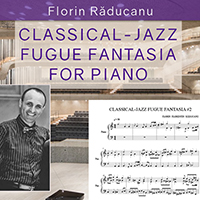
Florin Raducanu (Romania)- Fugue Fantasia for Piano
Classical-Jazz Fugue Fanstasia #2” is the second Piano Fugue addressed to both classical and jazz pianists.
In any case, the elements of Bachian Instrumental Counterpoint, jazz harmony, or compositional techniques from the developmental work serve as educational elements that show how jazz and classical music share an improvisational language (present in both Bach and Gershwin).
Like the previous “Jazz Fugue #1”, the new “Fuga Fantasia #2” follows the aesthetic path started by George Gershwin, very correctly understood by Maurice Ravel (see Sonata in G for violin and piano), Leonard Bernstein or John Williams in the creation of classical-jazz symbiosis.